For Keurig owners, ensuring the purity of water and the internal cleanliness of the machine is just as crucial as choosing the right coffee pod. Over time, minerals, scale buildup, and residual oils from brewed coffee can degrade flavor, promote bacterial growth, and reduce machine performance. That’s where well-maintained replacement filters, rinse pods, and descaling solutions come into play.
This guide covers three essential maintenance components for Keurig machines: replacement water filter cartridges (for Keurig 2.0 K-Cup systems), rinse pods / K-Cup cleaner pods, and descaling solution. You’ll find detailed technical specifications, material and design factors, expected service lifespans, third-party alternatives, and clear guidance on when to replace or use each. Whether you’re trying to preserve flavor clarity, extend your brewer’s life, or simply avoid unpleasant flavors or clogging, knowing which maintenance elements to use and when is key. Let’s dive in — starting with the water filter cartridges — so your Keurig can deliver its best cup, every time.
Replacement Water Filter Cartridges (for Keurig 2.0 K-Cup Pod Brewers)
Technical Details
Material & Media: Typically a plastic housing filled with activated carbon (often coconut-shell carbon) and ion-exchange resin beads (e.g. “diamonds” or polymer beads) to reduce chlorine, scale, heavy metals, and certain impurities.
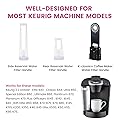
Dimensions: These cartridges are usually rectangular or cylindrical inserts sized to fit the water reservoir slot of Keurig 2.0 models. Approximate external dimensions are around 1 in × 1 in × 1.5–2 in (≈ 25×25×38–50 mm), but dimensions vary by model.
Flow rate / Throughput: Designed to handle typical daily brew volumes (e.g. up to ~200–300 mL per brew) without significant pressure drop.
Life Span / Usage
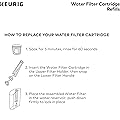
Keurig recommends replacing the water filter cartridge every 2 months or after 60 reservoir refills, whichever comes first.
In areas with very hard water, the effective lifespan may shorten due to faster clogging or saturation.
Important Features
High-quality activated carbon and ion-exchange beads to maintain flavor clarity and reduce off-tastes (chlorine, metallic flavors).
A snug fit in the reservoir housing, ensuring all water passes through the media (no bypass).
Durable housing resistant to cracking or leaching, safely food-grade plastic that can withstand repeated wet/dry cycles.
Some cartridges incorporate a fine mesh at the inlet to trap particulates or sediment.
Third-Party Filter Options
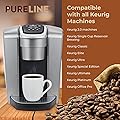
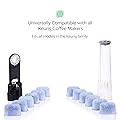
Several aftermarket brands produce “Keurig-compatible” replacement cartridges (for example, “Drinkmate,” “Mr. Coffee,” or generic third-party sellers) that fit Keurig 2.0 reservoirs.
Some users adapt carbon block filters or pitcher filter cartridges to fit with custom adapters.
Always verify dimensions, media quality (activated carbon + ion-exchange), and compatibility before purchase.
When to Replace
Every 2 months or 60 fills, per Keurig’s guideline.
Replace sooner if you notice slower water flow, off or stale tastes, or if you’re in a hard-water region and the filter becomes clogged or saturated quickly.
Always install a fresh filter after descaling to ensure full performance.
Keurig Rinse Pods – K-Cup Cleaner and Rinse for Keurig Single Serve Brewer Machines
Technical Details
Composition: Rinse pods (also called cleaning pods) are typically empty K-Cup shells containing food-safe citric acid or similar mild acids/cleaners. They often include a permeable filter material (paper or nylon) to control release of cleaning solution when hot water is forced through.
Size & Form Factor: They match the dimensions of a standard K-Cup pod used in Keurig machines (approx. 2 in diameter, ~1–1.5 in height), so that they fit and engage the piercing mechanism.
Dose / Concentration: The internal quantity of citric acid (or equivalent cleaner) is calibrated to dissolve in the brew’s hot water volume (e.g. 8–12 oz) to generate an effective rinse.
Life Span / Usage
Use one rinse pod per cleaning cycle — single-use.
Typically used weekly or between heavy usage sessions.
Important Features
Compatibility with the K-Cup chamber so it triggers the machine’s standard brew cycle and fully flushes the internal lines.
Adequate acid concentration to dissolve residual coffee oils, grounds, and light deposits.
Filter material must prevent large particles from entering the machine’s internal needles or tubing.
Safe components that won’t damage machine seals or internal parts.
Third-Party Filter Options
Various manufacturers (e.g. “Urnex,” “Full Circle Rinse Pod,” “Keurig® Pod Rinse”) offer rinse pods or equivalents.
Some users produce DIY rinse pods by filling empty K-Cup shells with citric acid or mild cleaner, though care is needed to match dosage.
When to Replace
Use one pod when the machine is idle for a few days, after brewing many cups, or if you detect off-flavors, sticky residue, or brewing irregularities.
Regular weekly use helps prevent buildup.
Always follow with at least one full water-only brew cycle to flush residual cleaner.
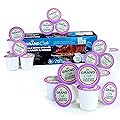
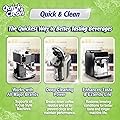
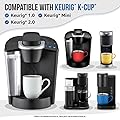
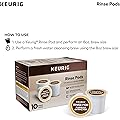
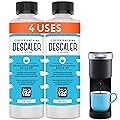
Descaling Solution For Keurig Machines
Technical Details
Composition: Typically a dilute acid solution (e.g. citric acid, lactic acid, or sulfamic acid) or a proprietary blend that dissolves mineral scale (calcium, magnesium). Some commercial kits use citric acid + proprietary buffer agents.
Concentration & Volume: For example, a typical Keurig descaling kit might come as a two-part solution (e.g. 1 part concentrate + water) or a single bottle to be diluted to fill the reservoir (e.g. ½ or 1 liter solution).
pH & Safety: The solution should be food-safe, non-corrosive toward internal parts (tubing, seals, metals), and manufactured to appropriate tolerances.
Life Span / Usage
Descaling is done periodically, not continuously.
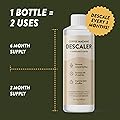
For households in moderate water hardness areas, descale every 3–6 months (about 3–4 times a year).
In hard water areas, more frequent descaling (e.g. every 1–3 months) may be needed.
Important Features
Effective at dissolving scale without damaging internal parts.
Safe for internal tubing, pump, valves, and seals used in Keurig machines.
Clear instructions and measured dose (so users don’t overdo or underdose).
Some solutions include built-in rinse safety (low residue after flush).
Compatibility with Keurig’s recommended descaling process (i.e. filling reservoir, running brew cycles, resting cycles, flushing).
Third-Party Filter Options
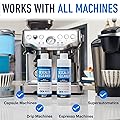
Many third-party descaling kits (e.g. “Urnex Dezcal,” “Full Circle Descaler,” “Powdx,” “Simple Green”) are marketed as compatible with Keurig machines.
DIY alternatives (e.g. diluted citric acid or white vinegar) can be used, but caution is needed: vinegar may damage seals or leave odor/taste.
Many users prefer citric-acid–based commercial kits, which are gentler and machine-safe.
When to Replace
Descale when you see the descaling indicator (if your machine has one), or if you notice slower brew times, weaker flow, or noisy pump.
At least every 3–6 months under moderate hardness; more frequently in hard-water areas.
Always run two full reservoirs of clean water (no pod) after descaling to flush residual solution.

Maintaining your Keurig machine isn’t just about choosing good coffee pods — it’s equally about keeping the water pathway, brewing channels, and internal parts clean and scale-free. With periodic replacement of the water filter cartridge, regular use of rinse/cleaning pods, and scheduled descaling, you safeguard flavor clarity, protect machine longevity, and avoid clogs or odd tastes. Stick to recommended intervals — two months for filters, weekly rinse pods, and quarterly descaling — and monitor performance. Do this, and your Keurig will continue brewing smooth, clean cups day after day.