Whether you’re aiming to maintain clean indoor air or simply prolong the life of your Blueair 211 series purifier, choosing the right replacement filter is essential. The Blueair 211 line—including the 211i Max, 211+, and associated variants—relies on multi-stage filtration systems to trap fine particles, allergens, odors, VOCs, and pollutants. As the filter media becomes saturated over time, airflow and filtration effectiveness decline, making timely replacement a must. While genuine Blueair filters are the default choice, many users now turn to third-party alternatives for cost savings or availability. In this post, we explore three primary filter options: the BLUEAIR Filter for Blue Pure 211i Max, the Blueair Blue Pure 211+ genuine replacement, and third-party replacement filters compatible with the Blueair 211+. For each, we’ll cover filtration capacity, lifespan, key performance features, when replacement is due, and trade-offs to consider when opting for third-party options. By the end, you’ll better understand how to balance cost, performance, and reliability when selecting a filter for your Blueair 211 purifier.
BLUEAIR Filter for Blue Pure 211i Max Air Purifier
Filtration Capacity & Features
The 211i Max filter (often a particle + carbon or multi-stage variant) is engineered to match the purifier’s high airflow design. It typically combines a dense particle filter layer with activated carbon to capture both particulate matter (down to ~0.1–0.3 µm) and gaseous pollutants such as VOCs, household odors, smoke, and chemical fumes.
Lifespan & Replacement Interval
Under typical indoor conditions, the 211i Max filter is rated for about 6 months of use, after which filtration efficiency begins to decline. Some units incorporate a sensor or algorithm (e.g. usage, fan speed, pollution load) to notify users when it’s time to change.
Important Features
High surface area and 360° intake design help reduce pressure drop and extend effective filter life.
The activated carbon layer is crucial for odor and gas removal.
The filter design may be proprietary—i.e. only fits the 211i Max model.
Third-Party Options
Third-party or generic filters labeled “compatible with Blue Pure 211i Max” may be available. These may use thinner media, lower carbon load, or cheaper construction. They can serve as interim replacements, but often fall short in longevity and gas capture. Always check particulate removal ratings (e.g. “HEPA equivalent,” “0.3 µm removal”), carbon weight, and user reviews.
When to Replace
Replace the filter when (a) the indicator light or algorithm signals end-of-life, (b) airflow noticeably drops, or (c) odors persist after extended use. In high pollution or dusty environments, you may need to change earlier (e.g. ~4 months).
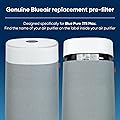
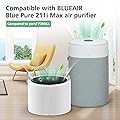
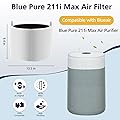
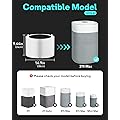
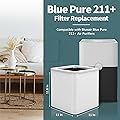
Blueair Blue Pure 211+ replacement filter
Filtration Capacity & Features
This genuine Blueair filter combines a particle filter (often polypropylene or electrostatic media) with an activated carbon mesh. According to Blueair, it removes allergens, pollen, dust, pet dander, mold, viruses/bacteria, and light household odors. Its design emphasizes 360° intake and large filter area to maintain airflow efficiency.
Lifespan & Replacement Interval
The official guidance is to replace the filter around 6 months of continuous use (though in mild use, some users extend to 9–12 months).
Important Features
RealTrack algorithm or sensor-based calculation (in “Auto” models) estimates remaining filter life based on fan speed, time, and pollution load.
Foldable design (in non-caged units) simplifies handling and replacement.
Balanced performance between particulate capture and carbon adsorption.
Third-Party Options
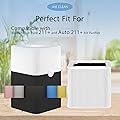
Many aftermarket filters claim “Blue Pure 211+ compatible” status. These alternatives may vary in carbon quantity, media density, or durability. They can be a cost-saving strategy, but risk gaps in guaranteed performance, faster saturation, or structural fit issues.
When to Replace
Change when the purifier indicates (red light or alert), or at baseline 6-month intervals. In heavy use or smoky/urban environments, earlier replacement (~4–5 months) is prudent. Monitor odor, dust levels, or pressure drop as cues.
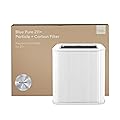
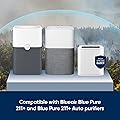
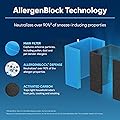
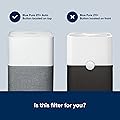
Blueair Blue Pure 211+ third party replacement filters
Filtration Capacity & Features
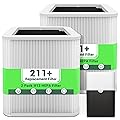
Third-party filters typically mimic the two-stage design (particle + carbon). Their parameters (media thickness, carbon amount, pore structure) vary by brand. High-quality ones may advertise “HEPA-equivalent” (99.97% at 0.3 µm), and show carbon weight or VOC reduction specs.
Lifespan & Replacement Interval
These filters often last less than the original, commonly in the range 3 to 6 months, depending on build quality and usage.
Important Features
Carbon loading: less carbon means weaker odor/VOC removal and saturation quicker.
Structural integrity: weaker adhesive or frame may allow bypass or sagging.
Dimensional tolerances: some third-party filters may have minor fit deviations.
Lack of sensor or algorithm integration: purifier may not detect “end of life” correctly.
When to Replace
Observe after ~3 months. If airflow falls, particle capture weakens, or odors persist, replace. In heavy-use or high-pollution conditions, changing every 3–4 months is safer.

Choosing the correct replacement filter for your Blueair 211 series is key to sustaining healthy indoor air and optimal performance. Genuine Blueair filters offer proven filtration, sensor-based life tracking, and reliable carbon absorption over roughly six months of use. However, third-party replacements can provide economical alternatives, albeit often with trade-offs in media quality, lifespan, and odor control. By understanding each filter’s capacities, limitations, and replacement triggers—whether for the 211i Max, the 211+ standard, or third-party options—you can strike the right balance between cost and cleanliness for your air purifier system.