Choosing the right replacement filter is essential to maintaining clean, healthy air throughout your home. The Coway Airmega line of whole-house or large-room purifiers (such as the 300, 300S, 400, 400S, and ProX) offers powerful filtration capacity, but even the best unit underperforms without timely filter changes. In this article, we examine three core replacement filter sets: the Coway Airmega 400 / 400S filter, the replacement filter set for Airmega ProX / large homes, and the filter set for 300 / 300S. For each, we’ll detail how much air they can clean, how long they last, their key features (particle + carbon layers, high surface area, etc.), and practical advice on when replacement is needed. We will also discuss the increasingly popular third-party filter options: while original Coway filters are engineered precisely for your unit, aftermarket alternatives may offer cost savings—but often come with trade-offs in longevity, filtration efficiency, or fit. Whether you own a 400S for open spaces, a ProX for larger square footage, or a 300S for more modest rooms, this guide will help you decide which filter path (OEM or third-party) best balances performance, reliability, and cost.
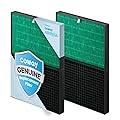
Coway Airmega 400s replacement filter for Home Large Room Air Purifiers Up to 3,120ft², 400, 400S
Filtration Capacity & Features
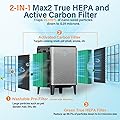
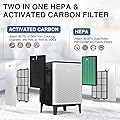
This filter is built to support the high airflow and broad coverage of the Airmega 400/400S. It usually consists of a multi-stage system: a pre-filter (for capturing large dust, hair, pet fur), a fine particle (HEPA or near-HEPA) layer that captures particles down to 0.3 µm (or smaller, depending on model), and an activated carbon layer for gas, odor, VOC, and chemical filtration.
Because the 400/400S is designed for very large rooms or open floorplans, the filter media is substantial in area and media depth to allow high throughput without excessive pressure drop.
Lifespan & Replacement Interval
Under normal indoor conditions, the standard lifespan is often 12 months. However, if used continuously or under heavy pollutant load (smoke, city air, cooking fumes), you may need to replace it earlier—perhaps at 6–9 months.
Important Features
High volume airflow support without clogging too fast
Thick carbon bed (for gases, odors)
Robust frame to avoid bypass or sagging
Possibly sensor metrics (for “smart” models) to track filter usage
Third-Party Options
Aftermarket or compatible filters for the Airmega 400 and 400S exist. These may reduce cost but often compromise on carbon weight, media density, adhesive/seal quality, or structural rigidity. In some cases, they may lack compatibility with the firmware or sensor feedback. Always verify claimed particulate removal (e.g. “99.97% at 0.3 µm”) and carbon loading specifications. User reviews can indicate whether the performance and fit are adequate.
When to Replace
When the purifier’s indicator (if available) signals end-of-life
When you notice reduced airflow or persistent odors
At least once a year under normal conditions; sooner under heavy pollutant stress
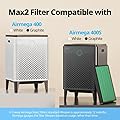
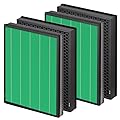
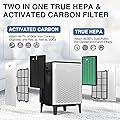
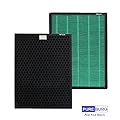
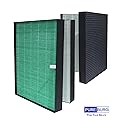
Replacement Filter Set for COWAY Air Purifiers for Large Room Whole Home Up to 4,253ft², ProX
Filtration Capacity & Features
This filter set is tailored for the most demanding settings (very large homes or open floorplans). It may include extra carbon capacity or more advanced particle media (higher surface area, denser pleats). Its design supports the ProX’s high clean air delivery rate (CADR) across a broad area.
Lifespan & Replacement Interval
Because of its enhanced construction, it may last around 12 months or more in favorable environments. But real-world users in dusty or urban settings might replace every 6–9 months.
Important Features
Enhanced carbon layer for improved gas/VOC removal across large spaces
Higher media surface area to sustain excellent airflow
Possibly modular or dual-filter designs for better coverage
Designed for compatibility with ProX model’s flow curves
Third-Party Options
A handful of third-party filter sets are made to match ProX / large-home specifications. Again, trade-offs may include thinner media layers, less carbon, weaker frame, or minor differences in dimensions. In extreme cases, firmware sensing may misread a lower-quality filter’s status. Always check user feedback and technical data sheets (if available).
When to Replace
Replace when alerts trigger or when performance (airflow, odor removal) degrades. In heavy-use settings, switching every 6–9 months is safer.
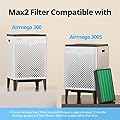
Replacement Filter Set for 300/300S
Filtration Capacity & Features
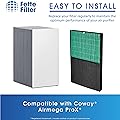
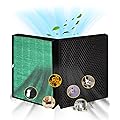
This is designed for smaller rooms or less demanding environments, but still uses high-efficiency media plus a carbon adsorption stage. It often features pleated HEPA-grade media, a pre-filter for coarse particles, and moderate carbon for odor and VOC filtering.
Because the airflow and volume are lower, the filter media is less bulky, but still optimized to balance filtration and airflow.
Lifespan & Replacement Interval
Under standard usage, the filter can last 9–12 months, sometimes a bit more in clean environments. But heavy pollutant exposure (pet, smoke, cooking) may warrant replacement at 6 months.
Important Features
Clean design suited for moderate CADR
Balanced media density so as not to stifle airflow
Adequate carbon bed to manage everyday odors
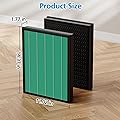
Easy installation and dimension match
Third-Party Options
Because the 300/300S is more common, there are more aftermarket substitutes available. Many of these will claim “HEPA equivalent” or “carbon enhanced.” Some may skip on carbon mass or weaken structural rigidity. Because the filter is smaller and simpler, the risk of performance gaps is somewhat lower—but still real. Always check removal efficiency, carbon weight, and user reviews.
When to Replace
At about 9–12 months in typical clean settings
At about 6 months under heavy pollutant load
Replace earlier if airflow slows noticeably, or odor issues persist
Maintaining optimum air quality through Coway Airmega purifiers depends largely on timely filter replacement. Genuine Coway filters are engineered for maximum airflow, durability, and gas/odor control over long usage intervals. Yet third-party replacements are increasingly viable alternatives—offering cost savings when selected judiciously—but may compromise on media quality, carbon loading, or lifespan. By comparing filters by capacity, features, replacement intervals, and real-world performance (especially with third-party options), you’ll better equip your Airmega system to deliver clean, healthy air without surprises.