Owning a Honeywell HPA300 (or one of its sibling models HPA100 / HPA200) means relying on high-efficiency filtration to keep dust, allergens, smoke, and odors out of your indoor air. But an air purifier is only as good as its filters — over time, HEPA media clog and activated carbon saturates, reducing airflow and compromising odor and VOC removal. That’s why timely replacement is essential for maintaining performance. While Honeywell offers its own replacement filters (HRF-R3, HRF-R2, HRF-R1, and associated activated carbon pre-filters), there is also a growing market of third-party or compatible alternatives. These third-party replacements may offer lower cost, competitive performance, or extra carbon load, but quality and fit are key. In this post, we examine three core replacement options: the HPA300 HEPA filter replacement sets (HRF-R series and activated carbon pre-filter), a general R-Filter compatible HEPA replacement (for HPA100/200/300/5000 series), and the HRF-A300 pre-kit allergen filter targeting dust, VOCs, pet odors, kitchen fumes, and smoke. For each, we’ll look at filtration capacity, lifespan, key features, available third-party choices, and guidance on when to replace so your purifier keeps operating at peak efficacy.
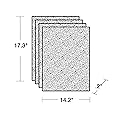
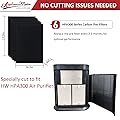
HPA300 HEPA Filter Replacement Sets for Honeywell Air Purifiers Filter HPA300 HPA200 HPA100 Series including Filter R-Replace HRF-R3, HRF-R2, HRF-R1 & HRF-AP1 Activated Carbon Pre-Filter
Filtration capacity & layers
These filter sets typically include a true HEPA filter that captures ≥ 99.97% of particles down to 0.3 µm (dust, pollen, mold spores, pet dander).
In addition, the set often includes an activated carbon pre-filter (or “pre-filter + carbon” mesh) that helps adsorb gaseous pollutants, VOCs, odors (cooking smells, smoke), and some chemical fumes.
The carbon pre-filter serves primarily as a sacrificial layer protecting the HEPA medium and capturing odor/gas load first.
Life span / replacement interval
Under normal residential conditions, the HEPA filter component is often replaced every 12 months.
The carbon pre-filter portion may saturate faster, particularly in homes with odors, cooking fumes, smoke, pets, or VOC sources — it may require replacement every 6 to 9 months or even sooner in heavy environments.
In high pollutant zones, consider semiannual checks to see if odor or airflow is reduced.
Important features
OEM matching: these sets are intended to match Honeywell’s original specifications (dimensions, airflow, gasket seals, media quality).
Balanced design: ensures pressure drop is acceptable even with combined HEPA + carbon burden.
Good sealing and frame integrity to avoid air bypass (which would degrade performance).
The carbon pre-filter helps extend the HEPA filter’s durability by absorbing gas load first.
Third-party filter options
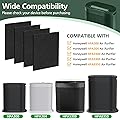
Several third-party brands offer replacement HEPA + carbon filter sets compatible with Honeywell HPA100/200/300 (HRF-R series). These often market greater carbon load, extended life, or enhanced media as a differentiator.
When choosing a third-party filter, key criteria include: matching thickness and dimensions, a robust gasket or frame to ensure seal, verified HEPA performance (ideally certified), and adequate carbon quantity/density for gas removal.
Be wary of ultra-cheap options with minimal carbon or weaker media, as they may degrade faster.
When to replace
Replace the carbon (pre-filter) portion when odor removal weakens or you begin detecting smells again — about every 6 to 9 months.
Replace the HEPA portion when airflow weakens or dust begins accumulating in the output, or at the 12-month mark under normal use.
In more polluted settings (smoke, heavy cooking, pets), shorten both intervals accordingly (e.g. every 6–9 months).
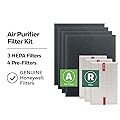
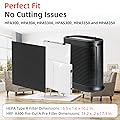
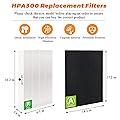
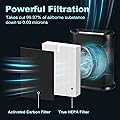
Air Purifier HEPA Filter R Replacement for Honeywell Air Purifier HPA100/200/300 and 5000 Series, Compatible with Honeywell R Filter (HRF-R3 & HRF-R2 & HRF-R1)
Filtration capacity & layers
This is a HEPA-only replacement, focusing strictly on particle filtration — capturing fine particulates such as dust, pollen, mold, pet dander, airborne allergens, and particulates down to 0.3 µm (≥ 99.97% capture, if quality).
It does not include a built-in carbon or gas adsorption stage, so odor and VOC removal are limited or nonexistent.
Life span / replacement interval
As a pure HEPA medium, under average indoor conditions it should last around 12 months, though in dusty, pet-heavy, or high particulate environments, performance may begin to decline earlier (e.g. 6–9 months).
Important features
Lower airflow resistance because there’s no carbon media, which can help maintain circulation efficiency.
Simple structure, so quality hinges largely on the density and uniformity of the HEPA media, frame rigidity, and air seal.
Without carbon, this option is best suited for environments where odor/gas pollution is minimal and the priority is particulate removal.
Third-party filter options
Many aftermarket “R-HEPA replacement” filters are marketed for the HRF-R series. Some are sold as drop-in replacements.
In evaluating third-party HEPA filters, consider the media’s quality (e.g. certified HEPA standard), frame strength, gasket/seal design, and consistency of airflow (i.e. minimal pressure drop).
Because these filters exclude carbon, cost savings are possible, but performance trade-offs (less odor control) must be understood.
When to replace
Replace when you detect reduced airflow, more dust buildup in your space, or sensor performance declining.
A practical schedule is about 12 months under normal use, or 6–9 months in active or dusty households.
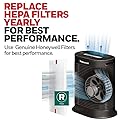
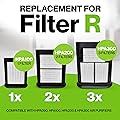
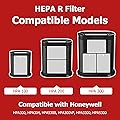
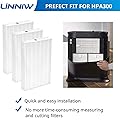
Honeywell HRF-A300 Air Purifier Pre Kit Filter – Allergen Air Filter Targets Dust, VOC, Pet, Kitchen, and Wildfire/Smoke Odors
Filtration capacity & layers
The HRF-A300 is a pre-kit or all-in-one “allergen” filter designed not just for particulate removal but also for capturing common indoor gases, odors, smoke, and allergens.
It usually comprises multiple layers: a pre-filter (mesh or foam) targeting large particles and hair, HEPA media for fine particles and allergens, and an enhanced activated carbon or chemical adsorption layer (or blended carbon/zeolite media) for VOCs, odors, smoke, cooking smells, pet odors, and wildfire-related compounds.
Life span / replacement interval
Because this filter handles both particle and gas loads, its functional lifespan is often shorter than HEPA-only filters. A realistic change interval might be 6 to 9 months under average conditions.
In environments with significant VOCs, smoke (wildfire, cooking), or pet odor load, replacement may be needed as early as 4 to 6 months.
Important features
Multi-layer design: helps pre-filter large debris, protect HEPA media, and actively reduce gases/odors.
Enhanced adsorption media: often uses denser carbon, impregnated carbon, zeolite blends, or other VOC-targeting media to improve chemical removal.
Versatility: well-suited for households concerned with smells, kitchen fumes, weak VOC sources, smoke or pets.
Needs good sealing: because gas adsorption is sensitive to leakage, frame gasket and seal are critical.
Third-party filter options
Some aftermarket “allergen / combo / odor + HEPA” kits are marketed for Honeywell HPA300 / HRF series compatibility. These may claim extra carbon, extended life, or superior chemical removal.
When evaluating, key considerations include: total carbon media mass, whether the carbon is impregnated (versus plain), the presence of additional adsorption media (zeolites, potassium permanganate), as well as HEPA media quality and structural integrity.
Beware of low-cost alternatives that under-spec carbon or use thin/low-quality adsorption media.
When to replace
Monitor for return of odors, decreased gas/odor removal, or increased dust presence.
In moderate use, replace every 6 to 9 months.
In heavy-use areas (smoke, cooking, pets), opt for a shorter interval (e.g. every 4–6 months) to retain optimal performance.
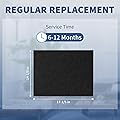
Maintaining your Honeywell purifier’s performance hinges on replacing filters before they lose effectiveness. Whether you opt for Honeywell’s official HRF-R and HRF-A300 series or a well-made third-party alternative, always verify that airflow, seal integrity, and filtration efficiency are preserved. Replace filters when performance drops (typically 6–12 months, depending on usage and environment). With proper upkeep, your purifier can continue delivering clean, healthier air for years.