Dyson air purifiers are prized for their sleek design, powerful airflow, and advanced filtration systems. But even the best purifier relies on timely filter replacement to maintain peak performance. Over time, HEPA media clogs and activated carbon adsorbents saturate, reducing airflow and diminishing the purifier’s capacity to trap particles and odors. Dyson offers official replacement filters for its TP, HP, BP, and DP series models, but an expanding market of third-party and aftermarket alternatives has emerged. These third-party filters often cost less and sometimes add tweaks (e.g. extra carbon or enhanced media), but their quality, fit, and longevity can vary. In this article, we’ll walk through three main replacement filter options: the 360° Combi Glass HEPA + Carbon filter for TP/HP/DP series, the 360° Glass HEPA filter for Dyson’s Pure Cool Link (TP/BP/DP) line, and the HEPA + Carbon Filter Set (formal dehyde / extra large) compatible for BP03 / BP04 / BP06 models. For each, we’ll explore filtration capacity, lifespan, standout features, third-party alternatives, and guidance on when to replace. Whether you want to stick with OEM quality or explore less costly options, you’ll be equipped to choose the best replacement for your Dyson unit.
360° Combi Glass HEPA + Carbon Filter #965432-01
Models supported / part reference
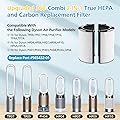
This combination filter is commonly used in Dyson’s TP09, TP07, TP06, TP04, TP10, TP4A, TP7A, HP04, HP06, HP07, HP09, HP10, HP4A, HP7A, and PH models (e.g. PH01, PH02, PH03, PH04, PH3A), as well as DP04 models. It corresponds to Dyson part 965432-01.
Filtration capacity & layers
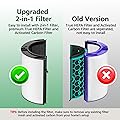
This is a dual-media “combi” filter: a true HEPA (glass fiber) stage plus a carbon (or activated carbon / gas adsorption) layer.
The HEPA section captures fine particles including PM2.5, dust, pollen, bacteria, and whisker-size particulates down to around 0.3 µm (with Dyson’s claim of ~99.97% capture).
The carbon layer helps reduce gases, VOCs, odors, and light chemical fumes (e.g. cooking smells, smoke).
Because it’s 360°, the filter encircles the airflow inlet, maximizing capture area and reducing resistance per unit area.
Lifespan / replacement interval
Under typical indoor conditions, Dyson recommends replacing this filter about every 12 months (or sometimes 6–12 months depending on usage, environment).
In heavy pollution, smoky, or odor-rich environments, the carbon media may saturate earlier, so performance degrades before a full year.
If you detect weaker odor removal or increased dust, it may be time earlier.
Important features
OEM fit and sealing guarantee which prevents bypass leaks and ensures full rated performance.
Optimized airflow and minimal pressure drop relative to filter area.
Balanced design between particle capture and gas/odor adsorption.
Dyson’s sensors and filter life indicator calibrate to this filter.
Third-party alternatives
Many aftermarket filters labeled “compatible with Dyson TP09 / HP series / 965432-01” are available.
Some third-party models boost carbon mass, add impregnated carbon types, or include supplementary adsorption media (zeolite, potassium permanganate, etc.).
Key checks: proper thickness (so it seats well), airtight gasket or frame to prevent leaks, good carbon density, and HEPA efficiency spec (ideally ≥ 99.97% at 0.3 µm).
Be cautious that some cheaper filters skimp on carbon or use lower grade media, reducing gas/odor removal.
When to replace
Replace when you notice diminished odor control, weak air output, or when Dyson’s filter indicator signals change.
In moderate use, ~12 months is common; in harsh or smoky settings, consider replacing every 6–9 months to maintain performance.
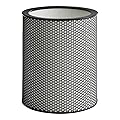
360° Glass HEPA Filter for Dyson Tower Purifier Pure Cool Link TP01, TP02, TP03, BP01, Compare to Part 968126-03
Models supported / part reference
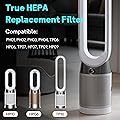
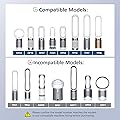
This filter fits Dyson’s tower / Pure Cool Link line: TP01, TP02, TP03, and sometimes BP01. The reference is comparable to Dyson part 968126-03.
Filtration capacity & layers
This is a HEPA-only type: a glass fiber HEPA element that handles particulate filtration (dust, pollen, allergens, PM2.5).
It does not include a carbon or gas adsorption layer, so it is meant primarily for particle removal rather than odors or VOCs.
Lifespan / replacement interval
Under normal indoor air use, it’s reasonable to replace every 12 months, since HEPA media gradually accumulates dust and loses flow efficiency.
In dustier or pet-hair heavy environments, replacement might be needed sooner (e.g. 6–9 months).
Important features
Because there is no carbon layer, airflow resistance is lower, which can help maintain stronger circulation.
Reliable particle filtration, assuming high quality media.
Less effective in odor / gas removal — supplemental adsorption media will be missing.
Third-party alternatives
Many third-party “HEPA for Dyson TP01/TP02/TP03 / 968126-03 compatible” filters exist.
Because these are simpler (no carbon), quality differentiation is more in media density and frame/gasket quality.
Choose filters with validated HEPA performance, sturdy frame support, and a good sealing edge.
When to replace
Replace when you notice reduced airflow, increased dust, or reduction in sensor responsiveness.
Typically around 12 months; shorter in dusty/pet environments.
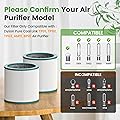
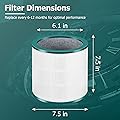
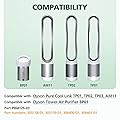
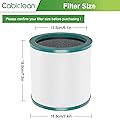
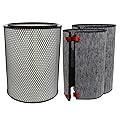
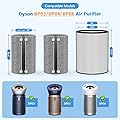
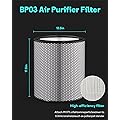
HEPA + Carbon Filter Set Compatible with Dyson BP03 BP04 BP06 Purifier Big+Quiet Formaldehyde Extra Large, HEPA + 2 Carbon Filter (972132-01 & 972133-02)
Models supported / part reference
This is a filter set intended for Dyson’s Big + Quiet or larger purifier models (BP03, BP04, BP06). The parts correspond to 972132-01 (HEPA) and 972133-02 (Carbon) (or combined HEPA + carbon sets).
Filtration capacity & layers
This is a dual media set: one part is the HEPA element, and the other is the carbon (or activated carbon / gas adsorption) module.
HEPA media captures fine particulate pollution (PM2.5, allergens, etc.).
The carbon module handles gases, odors, smoke, and VOCs.
Because this is a larger system, the media sizes are higher, allowing more capacity before saturation.
Lifespan / replacement interval
Under moderate indoor conditions, expect replacement every 12 months, though high-load environments (smoke, odors, VOCs) may demand earlier change.
Depending on which module (HEPA or carbon) saturates first, one may need replacement sooner than the other.
Important features
The modular design allows individual replacement of HEPA or carbon module (sometimes cheaper than full unit).
Better capacity due to size, so can handle higher loads.
The set matches Dyson’s airflow and sensor calibration for BP series.
Good gas/odor removal via carbon when needed.
Third-party alternatives
Some aftermarket filter kits for BP03/04/06 provide complete HEPA + carbon combinations or separate modules.
Some third-party filters emphasize heavier carbon, upgraded adsorption media, or extended life claims.
Key checks include module dimensions, seal integrity, carbon mass, and pressure drop characteristics.
When to replace
Replace when either gas/odor removal weakens or particle filtration seems compromised.
In many homes, 12 months is typical, though for households with smokers, pets, or pollutants, consider 9–12 months or sooner.
Maintaining fresh filters in your Dyson air purifier is essential to preserve air quality and system efficiency. While Dyson’s OEM filters ensure perfect fit and reliability, third-party alternatives offer flexibility and cost savings—provided you choose wisely. Replace your filters as needed (typically every 6–12 months, depending on load) and monitor performance (airflow, odor, sensor triggers). With the right filter in place, your Dyson will continue to deliver clean, healthy air for your space.