Whether you brew just a single cup or a large pot, loose-leaf tea aficionados often rely on tea infusers (or “tea balls”) to steep their leaves cleanly and conveniently. At Replacement Filter Shop, we offer three popular styles that match different brewing preferences: Stainless Steel Mesh Tea Balls, Long Handle Tea Balls, and Tea Balls With Charms. Each style brings its own advantages in terms of ease of use, aesthetics, and compatibility with teaware. In this post, we’ll walk you through the technical details (materials, sizes, pore fineness), expected longevity, standout features, recommended third-party options, and guidance on when to replace your infuser. Understanding these factors helps you choose the best one for your tea ritual — ensuring full leaf expansion, minimal sediment, and a clean, flavorful cup. Whether you’re steeping delicate green teas or hearty black blends, you deserve an infuser that suits your style and keeps your brew pure. Let’s dive into the details of each tea ball type so you can pick (or upgrade) with confidence.
Stainless Steel Mesh Tea Balls
Technical Details
Material: 304 (food-grade) stainless steel fine mesh / woven wire. Some models double-wall or reinforced at the rim.
Dimensions: Common diameters are 45 mm, 55 mm, or 65 mm (1.8–2.5 in) spheres, or dual-hemisphere sets for 1–2 cup usage.
Mesh / Pore Size: Often around 0.3–0.7 mm (300–700 µm) apertures to block larger leaf fragments while allowing infusion flow.
Construction: Hinged or clasp closure, often with a chain or hook attached.
Lifespan & Replacement
With proper care (rinsing, drying) these can last many years (3–10+ years) without degradation.
Replace if mesh deforms, welds loosen, rust spots appear, or the clasp fails.
Important Features
Durable, reusable, and non-reactive
Fine mesh helps reduce large leaf bits in brew
Fits many cups or teapots, especially sphere or basket designs
Easy to clean (brush or rinse)
Does not impart flavor or odor when well-maintained
Third-Party Filter / Infusers Options
Brands like OXO, Finum, Forlife, and others produce high-quality stainless steel infusers and mesh baskets.
Some offer ultra-fine mesh or dual-wall designs for finer teas.
Be cautious with cheaper steel that may corrode. Communities note so-called stainless tea balls sometimes develop rust if stored damp.
When to Replace
Replace if mesh is clogged and can’t be cleaned, or if the wire distorts / the hinge becomes loose.
Also if the clasp no longer seals tightly and tea leaves leak out.
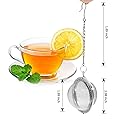
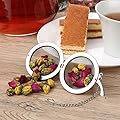
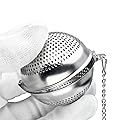
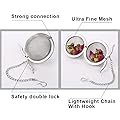
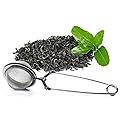
Long Handle Tea Balls
Technical Details
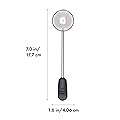
Material: Typically 304 stainless steel mesh or perforated plate, with a long stainless steel shaft or handle (often 10–20 cm).
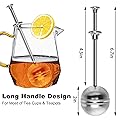
Dimensions: Mesh ball portion might be 35–50 mm in diameter; handle length 100–200 mm (4–8 in).
Mesh / Pore Size: Similar 0.3–0.8 mm mesh, or sometimes perforated with small holes ~0.5 mm.
Construction: The handle is welded or riveted into the ball; often with hanging hook or clip end.
Lifespan & Replacement
Undernormal use and proper care, can last several years (5+ years).
Replace when handle weld fails, mesh loosens, or corrosion begins.
Important Features
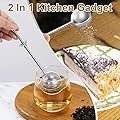
The long handle allows easy retrieval without immersing full infuser in pot (ideal for deep mugs or tall teapots)
Enables dipping, swirling — better infusion control
Compact mesh ball retains standard leaf-holding performance
No need for additional chain or hook in many cases
Third-Party Filter / Infusers Options
Many tea accessory brands (like Forlife, U Konserve, etc.) carry long-handled mesh infusers.
Some models include collapsible or folding designs.
Always confirm the welds and mesh quality before purchase.
When to Replace
Replace when handle becomes misaligned or detached, or when mesh integrity fails.
If it becomes difficult to clean or shows spots of rust or degradation.
Tea Balls With Charms
Technical Details
Material: Stainless steel mesh or perforated metal for the sphere, often paired with decorative charm (metal, enamel, or plated).
Dimensions: Typical ball size 40–55 mm diameter; charm length 10–30 mm depending on design; chain or link connecting charm and ball ~5–10 cm.
Mesh / Pore Size: Comparable to standard mesh (~0.4–0.8 mm holes) unless ultra-fine variant.
Construction: Charm attaches via a loop or chain to the infuser, often decorative (e.g. leaf, teapot, animal).
Lifespan & Replacement
Lifespan similar to standard mesh tea balls (several years) if well-maintained.
Replace when charm loop breaks, mesh degrades, or plating or charm parts corrode.
Important Features
Adds aesthetic appeal — charm acts as a handle or marker
Useful for differentiating infusers or as gift items
Charm can act as a counterweight so the ball sits properly in the cup
Still fully functional as infuser when the mesh is sound
Third-Party Filter / Infusers Options
Many artisanal or boutique tea accessory brands sell charm-style infusers (e.g. leaf, star, floral designs).
Check that the charm is food-safe, securely attached, and corrosion-resistant.
When to Replace
Replace when the charm connection weakens, or if mesh weakens.
If charm plating peels and flakes off into tea, it’s time to switch out.
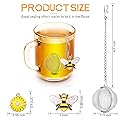

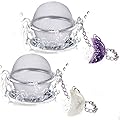
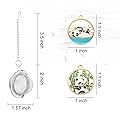
Tea ball infusers bring together convenience, reusability, and elegance in your brewing routine. Stainless steel mesh tea balls offer durability and fine filtration; long-handle tea balls provide reach and ease in taller vessels; and tea balls with charms add decorative flourish without sacrificing function. In all cases, proper cleaning and drying extend equipment life, but once mesh integrity fails or components degrade, it’s best to replace. By understanding their materials, sizes, and failure points — and knowing quality third-party alternatives — you can maintain a clean, flavorful brew for years to come.